Matrimony \MAT-ri-mohn-ee\
1. The right or sacrament of marriage; the act of marrying
2. The state or condition of being married; the relation between married persons
This word is decidedly French, coming from Ango-Norman matermoine which derives from 14th century Middle French matremoine (both have more than one spelling variation). The Old French version of the word conveyed a sense of "property inherited from one's mother". The word in Classical Latin is matrimonium ("state of being married") from the combination of matri + monium ("mother" from mater + "money").
There's also a word patrimony that dates to the mid-14th with the meaning "property of the Church" and "spiritual legacy of Christ." It comes from Old French patrimonie which derives from Latin patrimonium ("a paternal estate, inheritance"). The Latin word is a combination of pater + monium ("fater" from patris + "action, state, condition"). The sense of "property inherited from a father or ancestor" dates to the late 14th century. The figurative sense of "immaterial things handed down from the past" dates to the 1580's.
Thursday, March 31, 2011


Wednesday, March 30, 2011
Lucre
Lucre \LOO-kuhr\ , noun;
1. Monetary gain; profit; riches; money -- often with a negative connotation
This word dates to the late 14th century and comes from Latin lucrum ("gain, profit"), which is derived from the Proto-Indo-European base *lu-/*leu-.
Today's word and the first definition were both taken from Dictionary.com's 'Word of the Day' for Wednesday, March 30
Etymologies come from the Oxford English Dictionary and/or Etymonline.com
1. Monetary gain; profit; riches; money -- often with a negative connotation
This word dates to the late 14th century and comes from Latin lucrum ("gain, profit"), which is derived from the Proto-Indo-European base *lu-/*leu-.
Today's word and the first definition were both taken from Dictionary.com's 'Word of the Day' for Wednesday, March 30
Etymologies come from the Oxford English Dictionary and/or Etymonline.com
Tuesday, March 29, 2011
Bedaub
Bedaub \bih-DOB\ , transitive verb;
1. To smudge over; to besmear or soil with anything thick and dirty
2. To overdecorate; to ornament showily or excessively
Bedaub dates to the mid-16th century and is a combination of the prefix be- and daub.
Daub, as a verb, dates to the late 14th century from Old French dauber ("to whitewash, plaster"). Dauber, as a surname, is recorded from the mid-13th century and is presumably from the same Old French word. Old French dauber may be derived from Latin dealbare, a compound of de- + albare ("thoroughly" + "to whiten"). Albare comes from albus ("white"), which derives from the Proto-Indo-European base *albho- ("white"). Albus and *albho- are also the forebears of alb.
Today's word and the first definition were both taken from Dictionary.com's 'Word of the Day' for Tuesday, March 29
Etymologies come from the Oxford English Dictionary and/or Etymonline.com
Monday, March 28, 2011
Afflatus
Afflatus \uh-FLAY-tuhs\ , noun;
1. A divine imparting of knowledge; inspiration
This word dates to the 1660's from Latin afflatus ("a breathing upon, blast") from the past participle of afflare ("to blow upon"), which is a combination of ad- + flare ("toward" + "to blow"). Latin flare is actually related to English blow: Their common ancestor is Proto-Indo-European *bhle- ("to swell, blow up").
Today's word and the first definition were both taken from Dictionary.com's 'Word of the Day' for Monday, March 28
Etymologies come from the Oxford English Dictionary and/or Etymonline.com
1. A divine imparting of knowledge; inspiration
This word dates to the 1660's from Latin afflatus ("a breathing upon, blast") from the past participle of afflare ("to blow upon"), which is a combination of ad- + flare ("toward" + "to blow"). Latin flare is actually related to English blow: Their common ancestor is Proto-Indo-European *bhle- ("to swell, blow up").
Today's word and the first definition were both taken from Dictionary.com's 'Word of the Day' for Monday, March 28
Etymologies come from the Oxford English Dictionary and/or Etymonline.com
Sunday, March 27, 2011
Marmoset
Marmoset \MAR-muh-set\ or \MAR-muh-zet\ , noun,
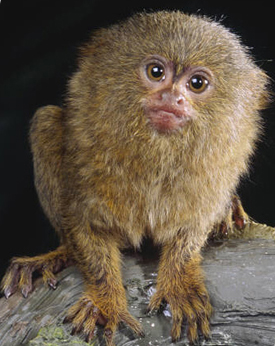 | |
| From FactZoo.com |
Originally this word meant "any small monkey," but it has evolved to refer to a specific family, Callitricidae, which live in Central and South America. More specifically, it usually refers to the genus Callithrix, which are about the size of a squirrel, have bushy tails and silky coats, and long tufts of hair on their ears or manes of hair. They are generally gentle and playful, and they used to be popular as pets.
Interestingly, although this word seems to have arisen in French, it has a post-Classical Latin counterpart that has had a colorful history of definitions since the 13th century: "cynocephalus*", "favorite of a ruler" (late 14th century), "little boy" (late 15th century), "kind of monkey" (16th century), and "young child" (mid-17th century).
* Cynocephalus is "dog-head" in Latin. Cynocephaly is the condition of having the head of a dog or jackal. It is a common element in several forms and contexts, including iconography of Egyptian gods, Medieval saints, and even Chinese legends.
Saturday, March 26, 2011
Verisimilitude
Verisimilitude \ver-uh-suh-MIL-uh-tood\ or \ver-uh-suh-MIL-uh-tyood\ , noun;
1. The appearance of truth; the quality of seeming to be true
2. Something that has the appearance of being true or real
This word dates to the 1600's from French verisimilitude, which is derived from Latin verisimilitudo ("likeness to truth"). The Latin word is from veri + similis (neuter of verus "true" + "like, similar"). Verus is the forebear of very and similis is the forebear of similar.
Today's word and the first definition were both taken from Dictionary.com's 'Word of the Day' for Saturday, March 26
Etymologies come from the Oxford English Dictionary and/or Etymonline.com
1. The appearance of truth; the quality of seeming to be true
2. Something that has the appearance of being true or real
This word dates to the 1600's from French verisimilitude, which is derived from Latin verisimilitudo ("likeness to truth"). The Latin word is from veri + similis (neuter of verus "true" + "like, similar"). Verus is the forebear of very and similis is the forebear of similar.
Today's word and the first definition were both taken from Dictionary.com's 'Word of the Day' for Saturday, March 26
Etymologies come from the Oxford English Dictionary and/or Etymonline.com
Friday, March 25, 2011
Bumptious
Bumptious \BUMP-shuh\ , adjective;
1. Crudely, presumptuously, or loudly self-assertive
This word is first attested in 1803 and is probably a humorous coinage based on the pattern of fractious, boisterous etc.
Today's word and the first definition were both taken from Dictionary.com's 'Word of the Day' for Friday, March 25
Etymologies come from the Oxford English Dictionary and/or Etymonline.com
1. Crudely, presumptuously, or loudly self-assertive
This word is first attested in 1803 and is probably a humorous coinage based on the pattern of fractious, boisterous etc.
Today's word and the first definition were both taken from Dictionary.com's 'Word of the Day' for Friday, March 25
Etymologies come from the Oxford English Dictionary and/or Etymonline.com
Subscribe to:
Posts (Atom)