Tuesday, June 7, 2011

Curb

Curb \kurb\ , noun;
1. A rim forming the edge of a sidewalk
2. An enclosing framework or border
3. A bit used with a bridoon for controlling a horse
verb;
1. To control; restrain; check
2. To cause to keep near the curb, as in 'curb your dog'
3. To furnish with or protect by a curb
4. To put on a curb

Curb, with the definition "strap passing under the jaw of a horse," dates to the late 15th century from Old French courbe ("curb on a horse"), which derives from Latin curvus from curvare ("to bend"). Ultimately the word derives from Proto-Indo-European *(s)ker- ("to turn, bend"). The meaning "enclosed framework" came about a century later in the 1510's, probably in keeping with the original notion of "curved." Curb as in "margin of stone between a sidewalk and road" is first attested in 1791 and is sometimes spelled kurb.

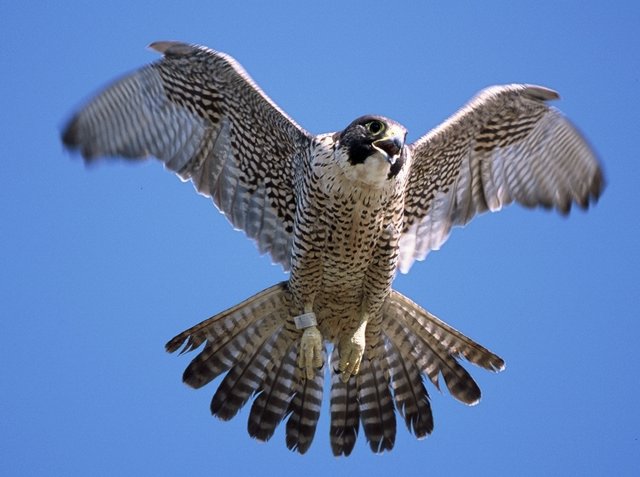
Now for the real reason I'm talking about curb today:
(Thanks Dad)

Monday, June 6, 2011

Pecksniffian

Pecksniffian \pek-SNIF-ee-uhn\ , adjective;
1. Hypocritically and smugly affecting benevolence or high moral principles

Like frabjous, lilliputian, and more, the origin of this word is an author's creativity. This one we can attribute to the great Charles Dickens. From January 1843 to July 1844 he wrote a monthly serial called 'The Life and Adventures of Martin Chuzzlewit' which included a greasy hypocrite named Mr. Pecksniff. Thus pecksniffian was born. It is first attested in 1851.

Today's word and the first definition were both taken from Dictionary.com's 'Word of the Day' for Monday, June 6
Etymologies come from the Oxford English Dictionary and/or Etymonline.com 

Sunday, June 5, 2011

Merkin

Merkin \MUR-kuhn\ , noun;
1. False hair for the female pudenda (aka: crotch wig)

I was listening to public radio today when I heard them talk about the Merkin Concert Hall at the Kaufman Center. I almost fell out of my chair because in my (apparently uncultured) mind merkin means only one thing. Maybe I should stop listening to Bob and Tom and start going to philharmonic concerts. Maybe not.

The origin of merkin is unknown, but it may be a variation of malkin ("a slattern, woman of the lower class," later "mop"). Merkin is first attested in the 1530's with the meaning "female pudenda" from the "mop" sense of malkin. In the early 1600's the meaning changed to meaning "artificial vagina" or "counterfeit hair for a woman's privy parts." Use of that 'counterfeit hair' by prostitutes dates to the mid-15th century. Ladies of the night would use the fake hair to cover the fact that their hair was lacking due to venereal disease or shaved to get ride of body lice.

In modern times the merkin is still in regular use, though not necessarily by prostitutes. They are common in Hollywood to avoid accidental 'full-frontal' nudity and to add hair if it's needed for historical accuracy. Decorative pieces are used, often in conjunction with nipple tassels or pasties, as part of a burlesque costume or applied to fake vaginas.

Apparently merkin is also common internet slang for American, which comes from a European slang term that dates to the 1960's. We can thank certain accents, particularly that of President Lyndon B. Johnson, and their pronunciation of American for that one.

Saturday, June 4, 2011

Defalcation

Defalcation \dee-fal-KEY-shuhn\ or \dee-fawl-KEY-shuhn\ , noun;
1. Misappropriation of money or funds held by an official, trustee, or other fiduciary
2. The sum misappropriated

This word dates to the late 15th century from Middle Latin defalcationem from the past participle stem of defalcare, which is a combination of de + falx/falcem ("sickle, scythe, pruning hook").

This term is specifically used in the United States Bankruptcy Code to describe certain bad acts connected to a debt that make that debt stand, even if bankruptcy is declared. Those 'bad acts' usually involve behaving recklessly with other peoples' money (while acting in a fiduciary capacity). Defalcation is also used in some legal proceedings to mean "embezzlement," particularly in the context of title insurance.
This guy's not involved (source)

Friday, June 3, 2011

Zyzzyva

Zyzzyva \ZIZ-uh-vuh\ , noun;
1. Any of various South American weevils of the genus Zyzzyva, often destructive to plants
A zyzzyva weevil (source)
This word is not in the Oxford English Dictionary so I can't account for an etymology, but its form is so crazy I had to put it here. It's the last word in most English dictionaries and would be a very impressive Scrabble word if you had a couple of blanks to account for the extra z's.

Thursday, June 2, 2011

Tooth

Tooth \TOOTH\

The origin of tooth is Old English toð (plural: teð) from Proto-Germanic *tanth/*tunth, which derived from Proto-Indo-European *dont-/*dent- which meant "tooth."

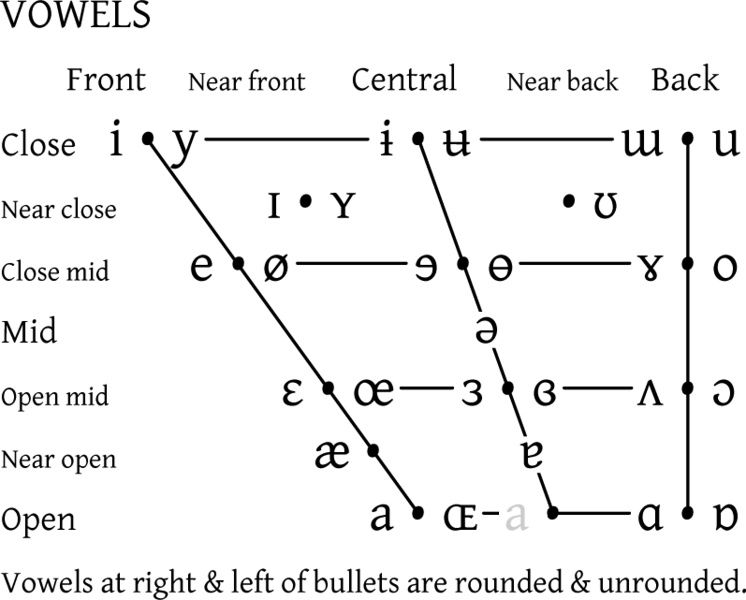
Tooth/teeth is one of those irregular English quirks that gives second-language learners headaches. It is the result of a type of sound change called 'i-mutation.' In phonetics, vowels are laid out in a map that corresponds to how the sound is made in the mouth.
Vowel Map (source)
 'Front' vowels are made closer to the lips and 'back' vowels are made towards to throat. To illustrate, consider the difference between the 'i' in feet and the 'u' in fudge. Alternate saying both sounds aloud and feel the way your mouth and tongue move for each sound. 'Close' and 'open' vowels have to do with how much space is between the tongue and the roof of the mouth. Alternate saying the vowel sound in feet and fat to feel the difference. I-mutation either moves back vowels to the front or makes front vowels more closed (moves them up), in some cases it does both. The vowel in tooth corresponds to the International Phonetic Alphabet (IPA) symbol [u] while the vowel in teeth corresponds to [i]. From the chart above you can see that the i-mutation involved in tooth/teeth is fronting a back vowel.

So why does i-mutation happen? Vowel changes usually happen to make word easier to pronounce. At some point in Old English toð was pluralized with the suffix -iz. Over time people started 'fronting' the 'o' sound in toðiz more like the 'i' in the suffix because it's easier to pronounce. Seem strange? Say the word doing aloud. Now say How you doing? as you would if you were talking to a friend. Notice how doing sounds a lot like diwin? That is i-mutation. We do it all the time.

Wednesday, June 1, 2011

Harissa

Harissa \hah-REE-suh\ or \huh-REE-suh\ , noun;
1. A pungent paste or sauce made with chilies, garlic, cumin, caraway, coriander, paprika, and olive oil, used as a condiment and flavoring in North African and Middle Eastern cookery
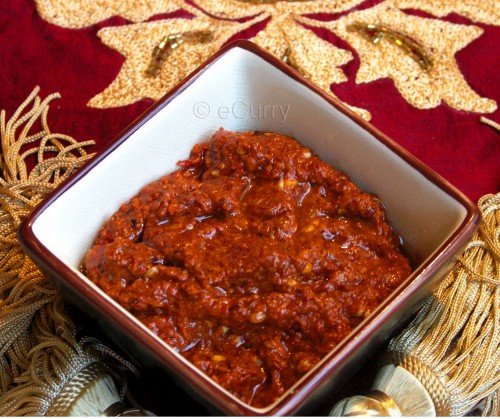
From eCurry - there's a recipe too!
This word is first attested in 1910 and it comes from Arabic harisa, which derives from harasa ("to crush, pound, tenderize by beating"). The extra 's' is probably influenced by French harissa, which is a condiment made from puréed or powdered chilies. Presumably French harissa comes from the same Arabic source.
Although the word harissa didn't make it to English until the last century, harisa has been around since at least medieval times. Originally it was a porridge-like dish made of ground wheat and tenderized meat pounded together. It was eaten by many Arabic-speaking peoples including those in Muslim Spain. It was also eaten as a Sabbath dish by Jews in Spain in the 13th century.